Fighting Back Against Legal Intimidation with AI Technology
It hits you like a virtual sledgehammer. You receive an email with a heading that stops you cold: "LEGAL NOTICE: Demand for Payment" or "LEGAL: Immediate Cessation Required." Your attention immediately shifts from business planning and growth strategies to one terrifying number. A claim seeking $50,000, $100,000, or even more for a supposed copyright breach or an old, forgotten debt. Your immediate reaction is to seek legal counsel, but that thought quickly leads to a second wave of anxiety when you learn about the retainer fee: $10,000, $15,000, or up to $25,000 for initial representation. Countless small business operators confront this difficult dilemma-a decision between a potentially business-ending settlement and a budget-breaking legal conflict.
Consider a third possibility? What if you could fight back intelligently, strategically, and affordably? For a growing number of entrepreneurs, that third option is becoming a reality through AI legal defense. This isn't about replacing lawyers entirely, but about changing the rules of the game. It's about leveraging advanced AI to analyze threats, prepare responses, and understand your rights before paying for traditional legal counsel. This is the story of how small business owners are turning the tables on legal bullies, reducing massive legal expenses, and discovering the strength to protect their enterprises in a world where legal threats are becoming increasingly common.
Essential Insights
- A Shift in Power Balance: AI tools are making it possible company leaders to handle many legal threats on their own, reducing dependency on costly attorneys for early defense phases.
- Education is Your Best Defense: The majority of legal challenges small businesses face are intimidation tactics based on flimsy legal grounds. Understanding the fundamentals of copyright law and debt validation can be your most powerful weapon.
- AI as a Research Assistant: AI systems can review legal paperwork, pinpoint issues in claims, and discover pertinent case law in a fraction of the time it would take a human, cutting down on expensive billable hours.
- Cost is a Major Factor: With standard attorney retainers starting from $10,000-$25,000, artificial intelligence-based solutions offer a cost-effective first line of defense for a fraction of the cost.
- Know When to Contact a Professional: Artificial intelligence is a helpful aid in preparation and early action, but it cannot serve as a replacement for a licensed attorney when dealing with active litigation or complex legal matters.
Essential Legal Considerations for Small Business Operations
The life of a small business owner involves managing numerous responsibilities. You're simultaneously the executive, marketing specialist, personnel manager, and sometimes even the custodian. Legal disputes are the last thing you need in your business journey. Unfortunately, contemporary business operations face numerous legal challenges. A 2023 study shows that small businesses in the United States lose $160 billion per year from legal disputes. These aren't just major lawsuits making headlines; these are the common legal threats that slowly deplete company resources.
The Rise of the Legal Intimidator
Numerous legal threats have little to do with justice; they are essentially a numbers game. Predatory firms, copyright trolls, and aggressive collectors dispatch countless threatening letters, knowing that some of targets will be too intimidated or uninformed to defend themselves. They count on the fact that the cost of hiring a lawyer usually cost more than the payment they're seeking. This produces a perverse incentive to settle, despite whether the demand is legitimate. These operations function as legal bullies, utilizing intimidation as their primary tactic.
Major Challenges for Business Owners
Although legal challenges can arise from multiple angles, a few common issues regularly plague small companies:
- Copyright Infringement Claims: Such claims are commonly connected to images utilized on corporate web pages and blogs. The majority of these claims are automated and sent without actual human oversight of context or fair use considerations.
- Debt Collection Notices: Collectors often send notices regarding outdated, disputed, or unverified debts. Collection companies commonly purchase debt for pennies on the dollar and utilize intimidating strategies to demand complete payment.
- Cease and Desist Letters: Such formal notices can cover various types of legal issues, from trademark disputes to contract violations. They are often used to deter competition or silence opposition.
- Banking and Payment Disputes: Conflicts with payment processors or banks can freeze accounts and halt operations, putting business operators in a defensive position.
For entrepreneurs facing these threats, it often seems like a full-blown crisis. However, the truth is that many of these issues are essentially matters of education and preparedness, instead of matters requiring litigation.
Small Business Legal Defense: The Hidden Costs of Traditional Approaches
The traditional approach for dealing with a legal issue is clear-cut: you hire a lawyer. For big companies with corporate legal staff and deep pockets, this is a routine cost of business operations. For a small company, it's a significant financial strain. The typical legal expenses for a small company is approximately $13,300 annually, but this amount can rise significantly when legal action occurs, with fees ranging from $3,000 to over $150,000.
Exploring Retainer Relationships
The primary upfront challenge is the attorney retainer. A retainer functions as a down payment for attorney representation, and in legal disputes, it's rarely below five figures. This results in what might be described as the "retainer trap." A company might face a demand for $8,000. An attorney estimates a $15,000 retainer to defend against it. From a financial perspective, the seemingly logical decision seems to be paying the $8,000 demand, even if the demand is without merit. This is the strategy that predatory litigants count on. They've strategically set their demands to be just below the cost of entry for mounting a legal defense.
Misaligned Incentives
Additionally, the standard legal model is based on billable hours. The more time spent on a case, the higher the lawyer's fees. Although responsible lawyers prioritize efficiency, the framework naturally incentivizes extended litigation and complex procedures. This presents a fundamental disconnect with what matters to small enterprise owners, who need fast, affordable, and effective resolutions. The main goal for the business owner is to resolve the issue, not to engage in a prolonged and expensive legal procedure.
How AI is Revolutionizing Legal Support for Entrepreneurs
Over the years, expensive legal representation created an enormous disparity in the market. No practical solution existed for entrepreneurs who weren't able to pay for an attorney but wouldn't yield to unfounded allegations. Machine learning is presently closing that gap. It's not a miracle solution, but it serves as a valuable resource that levels the playing field by significantly decreasing the financial and temporal requirements involved in the crucial first phases of defending against legal claims.
AI: Your Digital Legal Assistant
Consider AI as a paralegal possessing the capability and photographic memory to read enormous volumes of documents every minute. Let's explore its applications:
- Document Analysis: AI-powered solutions can efficiently examine legal documents and complaints and rapidly detect essential elements, like claimed violations, legal statutes referenced, and demanded compensation amounts. It can compare the document with thousands of similar cases to highlight trends and possible flaws.
- Legal Research: In place of an attorney dedicating hours (at $300+ per hour) researching case law, artificial intelligence can analyze legal resources and present pertinent legal examples in seconds. The system can identify details on consumer protection laws, fair use guidelines, or debt validation requirements pertaining to a case.
- Drafting Assistance: AI can help with drafting initial correspondence. When given the claim details and the relevant legal principles, it can produce a professional, organized response that establishes your position and puts the opposing party on notice that you are prepared to contest their claims.
Here's where everything shifts. The preliminary review and assessment, which usually amounts to thousands in legal fees, can be handled with a significantly lower expense in an artificial intelligence learning solution.
A Step-by-Step Guide to the AI Legal Defense Framework
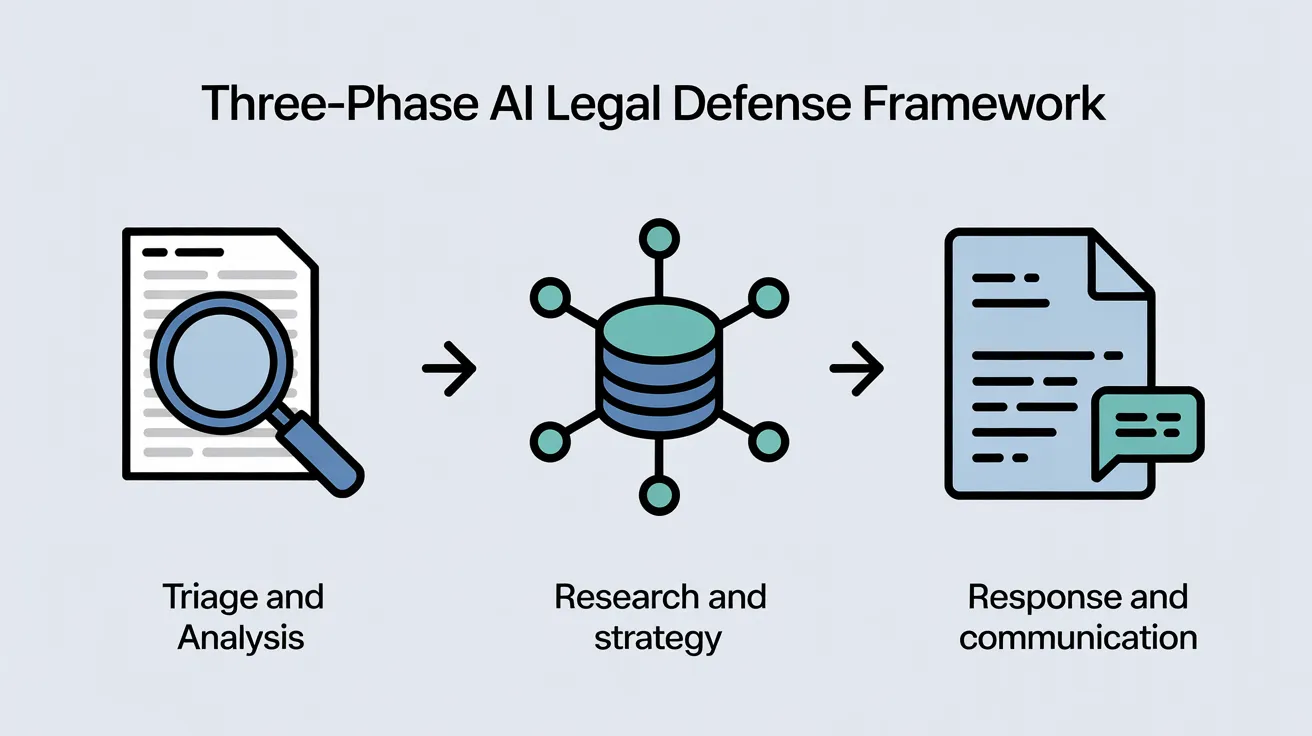
Implementing AI for legal defense goes beyond blindly relying on a chatbot. It involves adhering to a structured approach to evaluate the challenge, understand your position, and reply from a place of strength. This approach generally encompasses three critical phases.
Phase 1: Triage and Evaluation
To begin is to leverage artificial intelligence to analyze the situation at hand. You can input the legal threat or demand letter into an AI system and ask it to perform an preliminary review. The goal is to resolve several important points:
- What is the primary claim
- What specific laws or regulations are being referenced?
- Has the party making the claim proven they're the true rights holder?
- What evidence have they presented?
- Are there any immediate red flags or warning signs within their submission?
This first analysis helps you transition from a worried state to being well-informed and composed. It gives a straightforward, neutral assessment of the situation.
Step 2: Analysis and Strategy Development
When you grasp the claim, the next process is to use AI to investigate your defensive alternatives. For a copyright claim, you can ask the AI to research the four factors of fair use and their application in your individual situation. For a debt collection notice, you should ask it to detail the validation requirements under the Fair Debt Collection Practices Act (FDCPA). This process is centered on building your case. You are collecting the legal principles and facts that will form the basis of your response. This is also where you can initiate to recognize the shortcomings in your adversary's position.
Stage 3: Response Protocol
With your research finished, you can employ AI to help compose a response. This isn't about generating an automated letter. Rather, it focuses on using AI as your writing assistant. You supply the main arguments and relevant details, and AI assists in crafting them into a well-structured and polished response. Your response should typically:
- Acknowledge receiving their correspondence.
- Present your perspective clearly and concisely.
- Mention the specific legal concepts that reinforce your argument.
- Request extra details and validation, when necessary.
- Present information objectively without emotional bias.
This structured response demonstrates to the opposing side that you are organized, informed, and prepared to support your stance. It promptly shifts the situation from one of coercion to one of a professional legal discussion.
Managing Copyright Claims Through AI Analysis and Response
Copyright infringement issues remain one of the most common threats for digital enterprises. Organizations may incorporate an image in their content, and later face a demand for thousands of dollars from a stock photo company down the line. AI can be particularly effective in these situations.
Analyzing the Claim
Artificial intelligence software can aid in evaluating the legal demand. It reviews the demand letter to check whether it provides copyright ownership documentation, a valid registration number, and a clear explanation of the claimed violation. A lot of claim letters from aggressive copyright enforcers are intentionally vague and don't include this essential information. As entrepreneur Tony copyright of LinkDaddy found out, AI can be used to analyze the merit of a copyright claim, enabling the successful defense against a $500,000 copyright lawsuit without legal representation.
Understanding Fair Use Principles
Artificial intelligence serves as a powerful tool for researching the legal concept of fair use. Fair use represents a legal concept that allows the limited use of copyrighted material without permission from the rights holder. AI technology can support you grasp the four factors of fair use and how they might apply to your case, providing you with the reasoning you need to construct a robust defense.
AI-Powered Debt Collection Defense Strategies
Another area where AI is having a substantial effect relates to standing up to pushy collection agencies. The Fair Debt Collection Practices Act grants business owners and consumers specific rights, like the authority to ask for validation of a debt.
The Significance and Value of Validation Documentation
A debt collector is required to provide you with details about the debt, known as validation details. When you send a debt validation letter, you are formally requesting that the collector prove that you owe the debt and that they have the authority to collect it. Many collectors, specifically those who buy old debt, are unable to furnish this information. Artificial intelligence can help you with creating a complete debt validation letter that requests all the necessary information, such as:
- The original lender's name
- Your previous account number
- A copy of the initial signed contract.
- A full accounting of the purported balance due.
Delivering a proper validation letter often stops a debt collector from proceeding. When they fail to validate the debt, they are legally prohibited from pursue collection.
AI Legal Defense: Success Factors and Limitations
It is essential to be aware of the limitations of AI in the legal industry. AI acts as a learning and preparation resource, not a qualified lawyer. Identifying the difference between what you can address personally and when you require legal assistance is essential for a strong defense strategy.
Optimal Cases for AI Defense Implementation
- Initial Threat Assessment: Reviewing demand letters and cease and desist notices.
- Responding to Baseless Claims: Crafting professional replies to copyright trolls and debt collectors who rely on intimidation tactics.
- Legal Research: Analyzing the legal rights and the legal principles relevant to your situation.
- Organizing Your Case: Getting your documentation and arguments ready before consulting a lawyer, which can help you save thousands of dollars in attorney costs.
When You Should Hire an Attorney Immediately
There are certain situations when you shouldn't attempt handling your own legal defense. If you've been served legal papers, you should seek legal representation. Other scenarios demanding a lawyer's immediate attention include:
- Criminal charges.
- Regulatory investigations carried out by government agencies.
- Complex legal matters involving numerous parties or jurisdictional matters.
- High-stakes scenarios where the financial impact could ruin your company.
In such cases, the role of AI transforms from a primary defense mechanism to a supplementary resource. You can employ it to be better informed and ready as a client, but you must have a human expert supporting you.
Assembling Your AI Law Protection Arsenal
Starting AI legal defense doesn't require a background in computer science. It primarily needs a willingness to learn and availability of the appropriate tools. The foundation of your toolkit will be a capable language model like ChatGPT or Claude, paired with an educational platform that offers tailored prompts and frameworks for common legal threats.
The Vital Importance of Effective Prompts
The performance of any artificial intelligence tool depends on how well you craft your prompts. A general prompt like "write a response to this demand letter" will generate a generic and likely ineffective response. On the other hand, a detailed prompt will instruct the AI to perform a thorough analysis and produce a reply based on particular legal concepts. This is why platforms that offer proven prompts and frameworks are so important.
Real-World Success Stories: Small Businesses Fighting Back
The noteworthy example of Tony copyright, who protected his business over $511,000 by utilizing AI to combat three major legal threats, serves as a powerful illustration of what is possible. Yet he is not alone. Throughout the country, small business owners are discovering that they wield more power than they imagined. They are leveraging AI to contest baseless copyright claims and force debt collectors to validate their debts. These achievements are not merely about saving money; they are about reclaiming a sense of control and declining to be victims of a system that has traditionally been stacked against them.
Legal Defense: The Path Forward for Small Business Owners
The integration of AI into the legal sector is still in its early stages, but the direction is unmistakable. Access to legal assistance is becoming more attainable and cost-effective. The conventional guardians of the legal profession are facing disruption by technology that empowers small businesses and individuals. This doesn't suggest that lawyers will become obsolete. It indicates that their role will transform. They can concentrate on the sophisticated, challenging tasks that genuinely needs their expertise, while AI manages the more basic and preliminary work.
Business owners on a smaller scale, this signals an encouraging shift. It means that going forward, a legal threat may no longer be a source of monetary distress, but rather a challenge to be handled efficiently and thoughtfully.
Taking Action: Your First Steps with AI Legal Protection
If you are a small business owner, it's crucial to understand AI legal defense at this moment, ahead of potential challenges. Familiarize yourself with existing resources and solutions. Learn the basic principles of legal protection and financial recovery. With these preparatory actions, you can protect your business effectively. You can evolve from being an exposed entity into a knowledgeable guardian of your company's accomplishments.
Common Questions (FAQ)
Is AI genuinely useful for legal defense, or is it merely empty promises?
AI functions as an essential instrument for legal defense, but it's important to understand its role. It is not a replacement for a lawyer. Instead, think of it as a highly effective support tool for research and preparation. It can help you examine case materials, comprehend difficult legal concepts, and create initial drafts, all of which can save you a significant amount of time and money. The important thing is to employ it for the initial stages of a defense and to understand when to consult an experienced attorney.
How do I choose between AI tools and legal counsel?
Consider using AI tools for the first analysis of legal threats, when crafting responses to potentially unfounded claims (including those made by copyright trolls), and to structure your legal case. You should consult a lawyer right away if you have been served with a lawsuit, encounter criminal charges, or are managing a complex legal situation that could significantly impact your business. A good rule of thumb is: utilize AI for preliminary work, but turn to a lawyer to handle court proceedings.
What is the potential cost savings when using AI for legal defense?
The cost savings can be substantial. Attorneys often charge thousands of dollars for analyzing and responding to demand letters. An AI-based solution can accomplish this at a much lower price. When threats are resolved at this early stage, savings can reach tens of thousands of dollars. Even if legal representation becomes necessary, AI preparation can reduce attorney billable hours.
What are the key limitations of AI in legal contexts?
AI comes with several important limitations. It lacks legal standing and cannot serve as legal representation. It cannot match the nuanced understanding of a practiced legal professional and might not comprehend the intricacies of individual legal situations. Furthermore, it works with the data it was trained on, which might not be up-to-date. Most critically, artificial intelligence is limited to providing information and help, not legal counsel.
Is using utilizing AI for legal document analysis?
It is absolutely legal to utilize AI for document analysis and comprehension. You are just utilizing a technological aid for research and preparation, much like using a word processor or search engine. The key legal limitation is that you cannot represent yourself as a lawyer if you're not licensed, and the AI system cannot serve as your legal representative.
6. How can I tell if a legal threat is legitimate or merely pressure?
This is where AI analysis can be particularly useful. A legitimate legal threat will typically be specific, provide supporting documentation (like a copyright registration number), and come from a legitimate law firm. A scare website attempt, however, is usually unclear, is missing evidence, and frequently includes threatening or unsuitable language designed to force a hasty payment. AI helps you identify these red flags.
How does the Fair Debt Collection Practices Act (FDCPA) safeguard my rights?
The FDCPA serves as federal legislation that regulates the behavior of third-party debt collectors. The law shields you from deceptive, abusive, or unfair practices. A key protection offered is your right to request validation of the debt. When debt collectors fail to demonstrate that you owe the debt and their legal right to collect, they are required to cease collection activities. This serves as a vital safeguard for business proprietors who could be pursued for questionable or outdated debts.